by Emily Barney
WorldCat.org is an excellent tool to use if you would like to link to many sources housed in libraries around the world. To share these sources with other people, you can create a login and start making lists. You can make private lists, too, but public lists could be a great way to acquaint your local users with materials they could get using interlibrary loan if you can't afford to keep them in your collection.
Worldcat itself can sometimes be used for interlibrary loan - if your library is set up to do this, all the better reason to use these lists. You can annotate your list using the "details" tab or export citations in multiple formats by using the "citation" tab. We've created several lists for this project that you may have seen linked to in other posts, but here's the home page for them:
http://www.worldcat.org/profiles/GothamFreeLibrary/lists
I think it's pretty intuitive and fun to play with, but here's a little description if you don' t have time to play with it to figure it out:
You have to log in to add books to the lists or to make new lists. You can't comment on another person's list - it isn't a terribly "social" tool yet. It can also be hard to tell if you've already added a book when you work on adding new ones, but it still has some great features.
In the details view (the automatic tab) you can add notes about each book. The problem is, especially with long lists, you can only see 10 books at a time and it's hard to get to the end of the list.
In the "citation view" (the second tab) you can view a list of all the books in the list. You can sort the list several different ways, and you can choose between five different citation styles.
There are extra options only the person who makes the list can use:
You can write a short description paragraph that will show above the list, send the list to a group of people with a link to view it (how nice to use for a reading group or class!), or export the data. The Export data comes as a "CSV" file, which you can open as a table using most spreadsheet programs like Excel. And they have a handy print version too, that opens in a new window and will show all the books.
Showing posts with label resources. Show all posts
Showing posts with label resources. Show all posts
Tuesday, December 4, 2007

Sunday, December 2, 2007
Collection - Related Materials
by Emily Barney
While the first part of our collection development plan will focus on a core list of graphic novels, comics, and manga titles, it's worthwhile to remember that there are many related materials that may make the collection more accessible and interesting for library patrons with little experience in this genre.
Reference Books:
There are many, many "reference" books available for these types of materials. This small sample shows encyclopedias of characters, histories of different genres, bibliographies, literary criticism, biographies of artists and authors, and a "how to draw" book:

You can view many more examples by browsing through our Worldcat List:
Reference Books About Comics & Graphic Novels (46 items)
The titles displayed above are:
Don't forget that many fans also want to try their hand at creating their own "serial art" in the style of their favorite genre. There are hundreds of different books, ranging from simple "start with a circle" drawing books to specific guides for Manga transforming robots, cat-girls and villains.
It would probably be best to look at several examples once you know what your population skill level /interest level is. There are so many, but things like the quality of the explanations and how detailed the steps are will matter a lot in how useful your users find them. Books that just show pretty pictures and say "copy this!" are frustrating for beginners!
We have a couple lists of these on our Worldcat Lists page:
http://www.worldcat.org/profiles/GothamFreeLibrary/lists
Using a unified format and color scheme, like this one, can make any collection of drawings look great on a wall! Having their own art in the library will also encourage kids to bring in friends and family to see their work and build a sense of community ownership in the library.
Movies & Television - see this post
While the first part of our collection development plan will focus on a core list of graphic novels, comics, and manga titles, it's worthwhile to remember that there are many related materials that may make the collection more accessible and interesting for library patrons with little experience in this genre.
Reference Books:
There are many, many "reference" books available for these types of materials. This small sample shows encyclopedias of characters, histories of different genres, bibliographies, literary criticism, biographies of artists and authors, and a "how to draw" book:

You can view many more examples by browsing through our Worldcat List:
Reference Books About Comics & Graphic Novels (46 items)
The titles displayed above are:
- Goulart, Ron. 2004. Comic book encyclopedia the ultimate guide to characters, graphic novels, writers, and artists in the comic book universe. New York: HarperEntertainment.
- Gravett, Paul. 2004. Manga sixty years of Japanese comics. London: Laurence King.
- Gravett, Paul. 2005. Graphic novels everything you need to know. New York, NY: Collins Design.
- Kaplan, Arie. 2006. Masters of the comic book universe revealed! Chicago: Chicago Review Press.
- Lehmann, Timothy R. 2005. Manga masters of the art. New York: Collins Design.
- Misiroglu, Gina Renee, and David Roach. 2004. The superhero book the ultimate encyclopedia of comic-book icons and Hollywood heroes. Detroit: Visible Ink Press.
- Nagatomo, Haruno. 2003. Draw Your Own Manga: All the Basics. New York: Kodansha America.
- Robbins, Trina. 1999. From girls to grrrlz a history of [women's] comics from teens to zines. San Francisco: Chronicle Books.
Don't forget that many fans also want to try their hand at creating their own "serial art" in the style of their favorite genre. There are hundreds of different books, ranging from simple "start with a circle" drawing books to specific guides for Manga transforming robots, cat-girls and villains.
It would probably be best to look at several examples once you know what your population skill level /interest level is. There are so many, but things like the quality of the explanations and how detailed the steps are will matter a lot in how useful your users find them. Books that just show pretty pictures and say "copy this!" are frustrating for beginners!
We have a couple lists of these on our Worldcat Lists page:
http://www.worldcat.org/profiles/GothamFreeLibrary/lists
If you have a lot of kids interested in creating their own work, perhaps a contest to have their work displayed in the library would help create even more interest in the collection. Here's an example of graphic art on display in the Serieteket Library in Stockholm, Sweden:


Using a unified format and color scheme, like this one, can make any collection of drawings look great on a wall! Having their own art in the library will also encourage kids to bring in friends and family to see their work and build a sense of community ownership in the library.
Movies & Television - see this post
Collection Development
by Maura McKee
Graphic Novels n. A novel whose narrative is related through a combination of text and art, often in comic-strip form.
"graphic novel." (2003). In The American Heritage® Dictionary of the English Language. Retrieved November 08, 2007, from http://www.credoreference.com/entry/4092450graphic novel.
Graphic Novels n. A novel whose narrative is related through a combination of text and art, often in comic-strip form.
"graphic novel." (2003). In The American Heritage® Dictionary of the English Language. Retrieved November 08, 2007, from http://www.credoreference.com/entry/4092450graphic novel.
Since our grant determines our collection to be part of our Young Adult population, we have defined this as teens ages 12-18. In order to start developing our collection, we looked for current and well-regarded resources for finding the most appropriate titles for this age group. We want to purchase content that is popular and age appropriate. The term graphic novel for our collection will include manga titles and collections of comics in book format.
The first step in building this collection involved finding sources for reviews of graphic novels, determining awards specific to this genre, and compiling a list of popular publishers of graphic novels. We then chose the best reference books, websites, and catalogs for title recommendations.
After finding graphic novels for our collection we will likely expand our titles to include reference, drawing, and movie titles based on the comic book genre. Below you will find the top resources we found necessary for creating our graphic novel collection, including where to buy titles for this genre and where we will house our collection in the library.
Print Reviews:
 Publisher’s Weekly - http://www.publishersweekly.com
Published weekly
Includes Comics reviews for children and teens. Current best sellers, prize winners. Recent March 5, 2007 issue covers the 2007 Comic-con show in New York
 Booklist - http://www.ala.org/booklist/
Published twice monthly, includes graphic novel reviews
Recent March 15, 2007 issue “Spotlight on Graphic Novels” End of the year “Best Books” includes best graphic novels for teens. The ALA website also includes a YALSA sponsored “Great Graphic Novels for Teens” section. Here you will find 2007 nominations and winners, and well as, current nominations for 2008:
"Great Graphic Novels For Teens" website
http://www.ala.org/ala/yalsa/booklistsawards/greatgraphicnovelsforteens/gn.cfm
The Comics Journal http://www.tcj.com/
Published monthy
Provides industry news, interviews, and current reviews
School Library Journal http://www.slj.com
Published monthly
Includes starred reviews, best books of the year list in December issue
There are also many articles indexed in Wilson Web's Library Lit database. The two main subject areas are "comic books, strips, etc" and "graphic novels." If you search for these subject headings under "browse" you will find nice subheadings like "exhibits and displays" and "selection."
- Useful journals indexed by LibraryLit database:
- Library Journal
- Library Media Connection
- Young Adult Library Services
- several of the ones listed above as well.
Published Guides:
 The 101 Best Graphic Novels by Stephen Weiner, 2005 (1-56163-444-1)
This is a great title because every book in this list is assigned a reading level of :
- “C” for all ages, (especially 12 and under),
- “Y” for readers 12 and 15,
- “Y+” for teens 16-19,
- or “A” for adult readers ages 20 and up.
This is a good starting point to pick out the best titles that might fall in either the Y or Y+ category. For the purposes of our age group, we would likely start with the Y titles before choosing Y+. Stephen Weiner is a public library director and comics historian.
Developing and Promoting Graphic Novel Collections by Steve Miller, 2005 (9781555704612)
This thorough volume explains the details of developing, acquiring, cataloging, maintaining, and making displays for graphic novel collection in libraries.
To view examples of other reference books, see this post.
Or view our WorldCat list of 46 more titles here:
Collection Development for Comics, Manga, and Graphic Novels
Websites - see this post
Publishers - see this post
Catalogs & Booksellers:
- H.W. Wilson Core Collections http://www.corecollections.net/graphicnovels_copy(1).htm
- Provides recent picks for graphic novel and manga titles. Good source for finding current, popular titles. Also provides price, review sources, and reading levels.
- Brodart - http://www.graphicnovels.brodart.com/home.htm
- Maintains a graphic novel selection with core lists for long term availability. Other features include “New This Month” and Spanish Titles.
- Booksellers offering library discounts from 20-45%
- Ingram
- BWI
- Brodart
- Baker & Taylor
- Local Comic Book Shops or Bookstores
(includes more reference books, how to draw books, movies and television series)
Websites
by Emily Barney and Maura McKee
These websites are great resources for collection development, for finding the best ways to describe the materials, and for finding reviews and other information that can be used to share the resources with our patrons. If you're aware of other good websites, feel free to leave more addresses in the comments!
No Flying No Tights
http://www.noflyingnotights.com/index2.html
This popular website is perfect because it reviews Graphic Novels for teens.They even have a “core lists” section for librarians and teachers that want to start developing a collection.
Columbia University's Graphic Novels Page
http://www.columbia.edu/cu/lweb/eguides/graphic_novels/index.html
This website includes information about their own collection, including their collection development policy, and links to many more resources and guides. Their website provides both general-level information that would be interesting to fans and more specific information useful to librarians or anyone doing academic research in this field.
Gilles Poitras' http://www.koyagi.com
Includes a great "Librarian's Guide to Anime and Manga" and list of "Recommended Manga" as well.
Wikipedia
Wikipedia can be a wonderful source of information about these materials, often very well organized and documented with links to publishers, awards, and other relevant websites. Of course it would be wise to verify information from a more authoritative source, but the breadt h and depth of information available through these pages makes it a wonderful place to start. Here are a few of the applicable category pages where you can browse the sorts of information you can find on individual pages:
These websites are great resources for collection development, for finding the best ways to describe the materials, and for finding reviews and other information that can be used to share the resources with our patrons. If you're aware of other good websites, feel free to leave more addresses in the comments!
No Flying No Tights
http://www.noflyingnotights.com/index2.html
This popular website is perfect because it reviews Graphic Novels for teens.They even have a “core lists” section for librarians and teachers that want to start developing a collection.
Columbia University's Graphic Novels Page
http://www.columbia.edu/cu/lweb/eguides/graphic_novels/index.html
This website includes information about their own collection, including their collection development policy, and links to many more resources and guides. Their website provides both general-level information that would be interesting to fans and more specific information useful to librarians or anyone doing academic research in this field.
Gilles Poitras' http://www.koyagi.com
Includes a great "Librarian's Guide to Anime and Manga" and list of "Recommended Manga" as well.
Wikipedia
Wikipedia can be a wonderful source of information about these materials, often very well organized and documented with links to publishers, awards, and other relevant websites. Of course it would be wise to verify information from a more authoritative source, but the breadt h and depth of information available through these pages makes it a wonderful place to start. Here are a few of the applicable category pages where you can browse the sorts of information you can find on individual pages:
- USA Comic Books - there are separate categories by publisher, with amazingly detailed pages giving much more information about characters and history than you'll find even in the reference books. Here's are the top ones:
- Comic Strips (this category is primarily for "funnies" style comics)
- Graphic Novels - less useful than the Comic Book categories, but may grow in the future
- Webcomics - This is a hard category to quantify or review, since it is constantly changing, but the Wikipedia entry is as good a place as any to begin to familiarize yourself with them.
Awards
by Maura McKee and Emily Barney
Graphic novels have won awards in many categories, including a Pulitzer Prize for Art Spiegelman’s graphic novel Maus: A Survivor’s Tale, a memoir of his father’s survival of the holocaust.¹ There are also many awards dedicated just to comic books by genre or for achievement in specific fields.
The Hahnl Library's Comic Book Awards Almanac includes a glossary that explains the differences between these awards, from festival awards to nominations, polls and special selection awards.
You can find more information about the different awards on specific pages on Wikipedia including "Comic Book Awards," "Anime and Manga Awards" and "Award-Winning Graphic Novels"
Examples of awards given in this field:
 American Born Chinese, a graphic novel by Gene Luen Yang won the 2007 Michael L. Prinz Award for literary excellence in young adult literature. The novel interweaves three different stories:
 Jeff Smith's Bone is the longest-running self-published series so far and has won more awards than any other comic in history. It began with the whimsical adventures of Phone Bone and developed into an intricate world with monsters and dragons waging war against the forest creatures under the leadership of a cow-racing grandmother. It was released between 1991 and 2004, as 55 irregularly-released issues that were printed in 9 individual volumes and eventually gathered into one major volume, pictured here. This series has won 44 awards in America and around the world, including 10 Eisner Awards and 11 Harvey Awards.²
More information about the artist and series is available at http://www.boneville.com/
 Harvey Pekar and his wife Joyce Brabner wrote Our Cancer Year as he dealt with the discovery of his lymphoma and its treatment. The book was illustrated by Frank Stark, an award-winning professor of art at the University of Missouri. This volume won the 1995 best graphic album Harvey Award. Pekar had already won the American Book Award in 1987 for his American Splendor series. Pekar's life story -- including how he met and married Joyce Brabner, and how he experienced cancer and its treatment -- was made into an excellent film, American Splendor (2003).³
More information about the author and other graphic novels by him and his wife are available at http://www.harveypekar.com/
 Linda Medley's Castle Waiting was in YALSA's 2007 Top Ten Great Graphic Novels for Teens, and Booklist's Top 10 Graphic Novels for Youth. It has also won 2 Harvey Awards and 7 Eisner awards, including the 1998 Best New Series Eisner Award. Medley began the series in 1996 and volume one was published in 2006. The series begins with a short retelling of the Sleeping Beauty fairy tale, but once she has left for her happily ever after the castle becomes a refuge for marginal fairy tale creatures and characters, telling stories of unconventional convents and enterprising uses of the goose who laid the golden egg.
More information about the author and her book is available here: http://www.fantagraphics.com/artist/medley/medley.html
 Don Rosa's Life and Times of $crooge McDuck explains how the "richest duck in the world" won his fortune between 1877 and 1947. This historical fiction follows his adventures from Scotland to America and beyond to the African Transvaal, Australia, and the Klondike, encountering figures like Theodore Roosevelt. Published from April 1994 to February 1996, it won the 1995 Eisner Award for Best Serialized Story and the 1995 Comic Buyers Guide Fan Awards for Favorite Comic Book
More information is available about the series on Don Rosa's "The IntroDUCKtion to the Life and Times of $crooge McDuck"
¹ Kakutani, Michiko. "Books of The Times; Rethinking the Holocaust With a Comic Book." New York Times. October 29, 1991
² "The History of BONE & Jeff Smith" http://www.boneville.com/bone/bone-history/
³ Kohn, Martin "Brabner, Joyce and Pekar, Harvey: Our Cancer Year" Literature, Arts & Medicine Database 14 April 2005 http://litmed.med.nyu.edu/Annotation?action=view&annid=383
Graphic novels have won awards in many categories, including a Pulitzer Prize for Art Spiegelman’s graphic novel Maus: A Survivor’s Tale, a memoir of his father’s survival of the holocaust.¹ There are also many awards dedicated just to comic books by genre or for achievement in specific fields.
The Hahnl Library's Comic Book Awards Almanac includes a glossary that explains the differences between these awards, from festival awards to nominations, polls and special selection awards.
You can find more information about the different awards on specific pages on Wikipedia including "Comic Book Awards," "Anime and Manga Awards" and "Award-Winning Graphic Novels"
Examples of awards given in this field:
- Eisner Award - FAQ on comic-con international website
- Given for creative achievement in American comic books; named in honor of comic book writer and artist Will Eisner
- Harvey Awards - http://www.harveyawards.org/
- This series, named after writer artist Harvey Kurtzman, includes awards for achievement in writing, art, humor, letterer, colorist, new talent, etc. with comic books.
- Ignatz Awards - http://www.spxpo.com/ignatz.shtml
- Named for the character in the classic comic strip Krazy Kat by George Herriman this is a festival prize that recognizes outstanding achievement in comics and cartooning with special prizes in ten different categories.
 American Born Chinese, a graphic novel by Gene Luen Yang won the 2007 Michael L. Prinz Award for literary excellence in young adult literature. The novel interweaves three different stories:
 one is a folk tale of "The Monkey King", another is the story of a second-generation immigrant named Jin Wang, and the third is about Danny, a boy with a Chinese cousin named Chin-Kee. The book's climax merges all of these stories together.
More information about the author and the series is available at:
http://www.humblecomics.com/
More information about the author and the series is available at:
http://www.humblecomics.com/
 Jeff Smith's Bone is the longest-running self-published series so far and has won more awards than any other comic in history. It began with the whimsical adventures of Phone Bone and developed into an intricate world with monsters and dragons waging war against the forest creatures under the leadership of a cow-racing grandmother. It was released between 1991 and 2004, as 55 irregularly-released issues that were printed in 9 individual volumes and eventually gathered into one major volume, pictured here. This series has won 44 awards in America and around the world, including 10 Eisner Awards and 11 Harvey Awards.²
More information about the artist and series is available at http://www.boneville.com/
 Harvey Pekar and his wife Joyce Brabner wrote Our Cancer Year as he dealt with the discovery of his lymphoma and its treatment. The book was illustrated by Frank Stark, an award-winning professor of art at the University of Missouri. This volume won the 1995 best graphic album Harvey Award. Pekar had already won the American Book Award in 1987 for his American Splendor series. Pekar's life story -- including how he met and married Joyce Brabner, and how he experienced cancer and its treatment -- was made into an excellent film, American Splendor (2003).³
More information about the author and other graphic novels by him and his wife are available at http://www.harveypekar.com/
 Linda Medley's Castle Waiting was in YALSA's 2007 Top Ten Great Graphic Novels for Teens, and Booklist's Top 10 Graphic Novels for Youth. It has also won 2 Harvey Awards and 7 Eisner awards, including the 1998 Best New Series Eisner Award. Medley began the series in 1996 and volume one was published in 2006. The series begins with a short retelling of the Sleeping Beauty fairy tale, but once she has left for her happily ever after the castle becomes a refuge for marginal fairy tale creatures and characters, telling stories of unconventional convents and enterprising uses of the goose who laid the golden egg.
More information about the author and her book is available here: http://www.fantagraphics.com/artist/medley/medley.html
 Don Rosa's Life and Times of $crooge McDuck explains how the "richest duck in the world" won his fortune between 1877 and 1947. This historical fiction follows his adventures from Scotland to America and beyond to the African Transvaal, Australia, and the Klondike, encountering figures like Theodore Roosevelt. Published from April 1994 to February 1996, it won the 1995 Eisner Award for Best Serialized Story and the 1995 Comic Buyers Guide Fan Awards for Favorite Comic Book
More information is available about the series on Don Rosa's "The IntroDUCKtion to the Life and Times of $crooge McDuck"
¹ Kakutani, Michiko. "Books of The Times; Rethinking the Holocaust With a Comic Book." New York Times. October 29, 1991
² "The History of BONE & Jeff Smith" http://www.boneville.com/bone/bone-history/
³ Kohn, Martin "Brabner, Joyce and Pekar, Harvey: Our Cancer Year" Literature, Arts & Medicine Database 14 April 2005 http://litmed.med.nyu.edu/Annotation?action=view&annid=383
Collection - Movies & Television
by Emily Barney and Becky Haagsma
Another related group of materials are movies and television shows based on comic books, graphic novels and manga. For Manga, the animated equivalent is called "anime," but there are also live-action versions.
Since movies and television are a more universal pop culture media than comic books right now, the popularity of these movies could help you advertise and attract more users to a graphic novel collection.
Whether or not you would ever separate them out from your DVD collection, it would be worth having a short handout available in the Graphic Novel section and vice versa to help people browse to titles they'd be interested in. Here are a few examples:
 The titles displayed above are:
300 - American Splendor - AVP: Alien vs. Predator -Batman Begins - Blade - Blade II - Blade Trinity - Fantastic 4 - Fantastic 4: Rise of the Silver Surfer - Hellboy - Hulk - Popeye - Spider-Man - Spider-Man 2 - Spider-Man 3 - Superman Returns - V for Vendetta - X-Men - X2 - X-Men: The Last Stand
Movies & Television based on Comic Books:
Many popular recent movies and television shows have been based on comic book heroes and more are being planned all the time. There are also many others based on comic book "themes" and "superheroes" like Pixar's The Incredibles and NBC's Heroes.
One way to research these is to look in IMDB's keyword search. It works roughly like a "tagging" subject heading system. Here is the page for all the movies tagged "Based on a Comic book": http://www.imdb.com/keyword/based-on-comic-book/
The list of 422 items includes a few television series and is automatically sorted by rating. Sorting it by year is usually more helpful for collection development and will tell you if any new movies are being planned - which would help predict interest in graphic novel versions.
We have also created a list of popular movies based on graphic novels & comic books that can help you find these through library catalogs: Movies Based on Comic Books & Graphic Novels
Movies & Television based on Manga:
For Manga, the animated version, both for movies and television shows, is known as Anime (these are both very basic translations from Japanese - manga simply means comic in Japanese, Anime simple means animated films)
It is very common for a manga series, when it has gathered enough momentum and has a long series of books with a loyal fan base, to be converted to an anime television series. Fruits Baskets, for instance, has been extremely popular both as a Manga series and as a televise Anime series and both have been translated into English.
The website Anime on DVD has a great listing of Anime based on Manga series:
http://www.animeondvd.com/specials/manga/compcharts.php?view=manga
Another related group of materials are movies and television shows based on comic books, graphic novels and manga. For Manga, the animated equivalent is called "anime," but there are also live-action versions.
Since movies and television are a more universal pop culture media than comic books right now, the popularity of these movies could help you advertise and attract more users to a graphic novel collection.
Whether or not you would ever separate them out from your DVD collection, it would be worth having a short handout available in the Graphic Novel section and vice versa to help people browse to titles they'd be interested in. Here are a few examples:
 The titles displayed above are:
300 - American Splendor - AVP: Alien vs. Predator -Batman Begins - Blade - Blade II - Blade Trinity - Fantastic 4 - Fantastic 4: Rise of the Silver Surfer - Hellboy - Hulk - Popeye - Spider-Man - Spider-Man 2 - Spider-Man 3 - Superman Returns - V for Vendetta - X-Men - X2 - X-Men: The Last Stand
Movies & Television based on Comic Books:
Many popular recent movies and television shows have been based on comic book heroes and more are being planned all the time. There are also many others based on comic book "themes" and "superheroes" like Pixar's The Incredibles and NBC's Heroes.
One way to research these is to look in IMDB's keyword search. It works roughly like a "tagging" subject heading system. Here is the page for all the movies tagged "Based on a Comic book": http://www.imdb.com/keyword/based-on-comic-book/
The list of 422 items includes a few television series and is automatically sorted by rating. Sorting it by year is usually more helpful for collection development and will tell you if any new movies are being planned - which would help predict interest in graphic novel versions.
We have also created a list of popular movies based on graphic novels & comic books that can help you find these through library catalogs: Movies Based on Comic Books & Graphic Novels
Movies & Television based on Manga:
For Manga, the animated version, both for movies and television shows, is known as Anime (these are both very basic translations from Japanese - manga simply means comic in Japanese, Anime simple means animated films)
It is very common for a manga series, when it has gathered enough momentum and has a long series of books with a loyal fan base, to be converted to an anime television series. Fruits Baskets, for instance, has been extremely popular both as a Manga series and as a televise Anime series and both have been translated into English.
The website Anime on DVD has a great listing of Anime based on Manga series:
http://www.animeondvd.com/specials/manga/compcharts.php?view=manga
Graphic Novel Libraries - Around the World
by Emily Barney
I remember reading an article from NY Times article last year about some really interesting businesses in Japan that cater to Manga addicts. It might not directly apply to a startup collection in the U.S., but I think it shows the direction that teen libraries might be heading in, with easy access to entertainment in multiple media forms from manga to internet to video games and DVDs. We just don't serve clean underwear or massage chairs yet. ;)
In Tokyo, the New Trend Is 'Media Immersion Pods' By VIRGINIA HEFFERNAN
Published: May 14, 2006
I found lots of pictures on flickr of Manga libraries in Japan, from little roadside collections to huge stores and cybercafes like the one in the article with rentable cubicles:
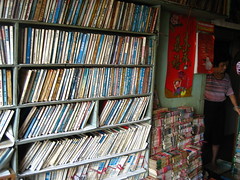
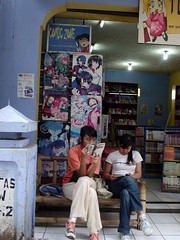
Woman & Her Comic Lending Library "Convenience Mart" style "comics library"
Originally uploaded by The Kozy Shack Originally uploaded by Ikhlasul Ama
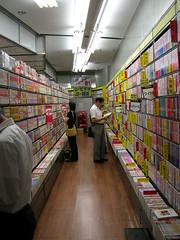
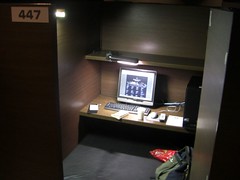
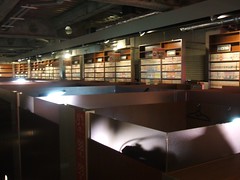
Beyond Japan, I also saw pictures of a really awesome graphic novel library in Stockholm. Since the whole library is dedicated to this genre of literature, the images of the layout and storage options is very informative for our project. Michael Casey, who writes the LibraryCrunch blog, has a slideshow of more images here. I sent him an e-mail and he was nice enough to say I could use any of his photos for our website, he would just like to see it when it's up.
I remember reading an article from NY Times article last year about some really interesting businesses in Japan that cater to Manga addicts. It might not directly apply to a startup collection in the U.S., but I think it shows the direction that teen libraries might be heading in, with easy access to entertainment in multiple media forms from manga to internet to video games and DVDs. We just don't serve clean underwear or massage chairs yet. ;)
In Tokyo, the New Trend Is 'Media Immersion Pods' By VIRGINIA HEFFERNAN
Published: May 14, 2006
I found lots of pictures on flickr of Manga libraries in Japan, from little roadside collections to huge stores and cybercafes like the one in the article with rentable cubicles:
Woman & Her Comic Lending Library "Convenience Mart" style "comics library"
Originally uploaded by The Kozy Shack Originally uploaded by Ikhlasul Ama
Manga library Kyoto "Room" in a Cyber-Cafe "Library
Originally uploaded by Tim Eyles Originally uploaded by yoni.holmes
Originally uploaded by Tim Eyles Originally uploaded by yoni.holmes
Beyond Japan, I also saw pictures of a really awesome graphic novel library in Stockholm. Since the whole library is dedicated to this genre of literature, the images of the layout and storage options is very informative for our project. Michael Casey, who writes the LibraryCrunch blog, has a slideshow of more images here. I sent him an e-mail and he was nice enough to say I could use any of his photos for our website, he would just like to see it when it's up.
Sunday, November 18, 2007
Preservation and Maintenance
by Becky Haagsma
Caring for our Graphic Novel Collection
 A problem mentioned by some libraries that have graphic novels is the fragility of the bindings, especially Manga. Large serial anthologies published with several volumes in one paperback (such as the Bone Complete Cartoon Epic in one volume) seem like they would be prone to split spines. When individual volumes are available, especially in hardback, the durability may justify the extra expense. Heavy and perhaps rough usage from teens also exacerbates problems with paperback bindings. Some library staff members also fear graphic novels will be stolen.
However, these arguments are no reason to fear putting a collection in place. We could use the same arguments against magazines, DVDs, CDs, and any paperback books. Graphic novels will be well worth the effort of maintaining the collection! Still, it is wise to be prepared to take some preventative measures, and be ready to do some maintenance and mending. While there isn’t a lot of research on how libraries can care for graphic novels, it is occasionally a topic on listservs, including GNLIB (Graphic Novels in Libraries). I also e-mailed the YALSA listserv to see if I could get some advice.
Preventative Care
Ching and many others recommend taping the spines. Members of the GNLIB-L listserv write that laminating or contact-papering the entire covers has made a tremendous difference in wear. Kat Kan suggests using two-inch-wide clear book tape to reinforce the spines and inner gutters.
Another very simple thing that has been done at libraries to reduce wear is to just make sure they have ample room in the graphic novel area and display the books face-out. This seems to reduce stress on the spine:
Mending and Maintenance
For mending worn-out copies with split spines, librarians suggest carefully tipping in pages or gluing in sections with book glue. In an e-mail to me, Kan recommended using good quality book glue, such as Norbond (from Demco). Some librarians also use paper hinge tape. If the book is thin enough and has enough space in the gutter of the book, we could use heavy-duty staplers to staple the books back together. Other libraries have also used plastic comb bindings for graphic novels that had fallen apart, but I see this as a last resort since these bindings can come apart fairly easily as well.
Buying Options
Gordon Wyant from Bellevue Public Library responded to my questions posted to the YALSA listserv. He wrote that the big anthologies that collect 5-10 of the monthly comics in a medium sized paperback get some of the most circulation, after Manga titles. His library orders these titles from BWI in their prebound format. It lengthens the life of the title a great deal and is well worth the money spent to get it bound. Kan also commented on book distributors that offer libraries reinforced bindings for graphic novels, for a higher price.
Out-of-Print Issues
It will be important to try to keep the books in good condition. Sometimes graphic novels go out of print and it can be hard to find a replacement copy. This especially presents a problem when the missing item is in the middle of a series. In Kan's e-mail she explained that, depending on the publisher, “out of print” can mean forever, or can mean the book will be published again in a year or so. This is especially true with publishers like Marvel, which puts trade paperbacks out of print fairly quickly and then republishes them again in a while with a new cover so collectors will want to buy each edition. For Manga, most of the time the series will go out of print because the publisher has lost the license to publish the English translation in the US. Sometimes they may come back with other publishers.
If items really are out of print, finding them can be tricky. Wyant explained that when he needs to find a replacement for an out of print item, he checks his distributors first (BWI and Ingram). While the item may be out of print, the distributor may still have some copies in their warehouses. If that is not the case, he suggests checking local comic stores. They can be an invaluable resource for older items and if they don't have it, they might be able to point you to someplace that will. Finally, if we get really desperate, he suggests checking Amazon Marketplace. You can often find out of print titles in good to perfect condition, although it can be difficult finding the title for a decent price. It also takes some time, but it can fill holes in series from time to time and is worth checking.
Resources
Bucher, Katherine T., and M. Lee Manning. "Bringing Graphic Novels into a School's Curriculum." The Clearing House 78.2 (2004): 67-72. Professional Development Collection. EBSCOhost. UIUC Library. 27 Oct. 2007 http://search.ebscohost.com/login.aspx?direct=true&db=tfh&AN=15348082&site=ehost-live.
Ching, Alison. "Holy Reading Revolution, Batman! Developing a Graphic Novel Collection for Young Adults." Young Adult Library Services 3.4 (2005): 19-21. LISA. EBSCOhost. UIUC Library. 18 Nov. 2007 http://search.ebscohost.com/login.aspx?direct=true&db=tfh&AN=18797219&site=ehost-live.
GNLIB (Graphic Novels in Libraries) listserv. www.angelfire.com/comics/gnlib/. Thread began 20 July 2000 “Re: Mike Pawuk's Appearance and a question” then changed to “RE: ...and a question” and “RE: help for GNs falling apart.” Retrieved 18 Nov. 2007 http://lists.topica.com/lists/GNLIB-L/read?sort=d&start=300.
Kan, Kat. "Getting Graphic at the School Library." Library Media Connection 21.7 (2003): 14. Academic Search Premier. EBSCOhost. UIUC Library. 27 Oct. 2007 http://search.ebscohost.com/login.aspx?direct=true&db=aph&AN=9467494&site=ehost-live.
Kan, Kat. "Re: [yalsa-bk] Graphic novel collection--keeping the novels in good shape." E-mail to Rebecca Haagsma. 28 Oct. 2007.
Wyant , Gordon . "Re: [yalsa-bk] Graphic novel collection--keeping the novels in good shape." E-mail to Rebecca Haagsma. 29 Oct. 2007.
Caring for our Graphic Novel Collection
 A problem mentioned by some libraries that have graphic novels is the fragility of the bindings, especially Manga. Large serial anthologies published with several volumes in one paperback (such as the Bone Complete Cartoon Epic in one volume) seem like they would be prone to split spines. When individual volumes are available, especially in hardback, the durability may justify the extra expense. Heavy and perhaps rough usage from teens also exacerbates problems with paperback bindings. Some library staff members also fear graphic novels will be stolen.
However, these arguments are no reason to fear putting a collection in place. We could use the same arguments against magazines, DVDs, CDs, and any paperback books. Graphic novels will be well worth the effort of maintaining the collection! Still, it is wise to be prepared to take some preventative measures, and be ready to do some maintenance and mending. While there isn’t a lot of research on how libraries can care for graphic novels, it is occasionally a topic on listservs, including GNLIB (Graphic Novels in Libraries). I also e-mailed the YALSA listserv to see if I could get some advice.
Preventative Care
Ching and many others recommend taping the spines. Members of the GNLIB-L listserv write that laminating or contact-papering the entire covers has made a tremendous difference in wear. Kat Kan suggests using two-inch-wide clear book tape to reinforce the spines and inner gutters.
Another very simple thing that has been done at libraries to reduce wear is to just make sure they have ample room in the graphic novel area and display the books face-out. This seems to reduce stress on the spine:
Mending and Maintenance
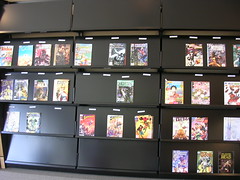
For mending worn-out copies with split spines, librarians suggest carefully tipping in pages or gluing in sections with book glue. In an e-mail to me, Kan recommended using good quality book glue, such as Norbond (from Demco). Some librarians also use paper hinge tape. If the book is thin enough and has enough space in the gutter of the book, we could use heavy-duty staplers to staple the books back together. Other libraries have also used plastic comb bindings for graphic novels that had fallen apart, but I see this as a last resort since these bindings can come apart fairly easily as well.
Buying Options
Gordon Wyant from Bellevue Public Library responded to my questions posted to the YALSA listserv. He wrote that the big anthologies that collect 5-10 of the monthly comics in a medium sized paperback get some of the most circulation, after Manga titles. His library orders these titles from BWI in their prebound format. It lengthens the life of the title a great deal and is well worth the money spent to get it bound. Kan also commented on book distributors that offer libraries reinforced bindings for graphic novels, for a higher price.
Out-of-Print Issues
It will be important to try to keep the books in good condition. Sometimes graphic novels go out of print and it can be hard to find a replacement copy. This especially presents a problem when the missing item is in the middle of a series. In Kan's e-mail she explained that, depending on the publisher, “out of print” can mean forever, or can mean the book will be published again in a year or so. This is especially true with publishers like Marvel, which puts trade paperbacks out of print fairly quickly and then republishes them again in a while with a new cover so collectors will want to buy each edition. For Manga, most of the time the series will go out of print because the publisher has lost the license to publish the English translation in the US. Sometimes they may come back with other publishers.
If items really are out of print, finding them can be tricky. Wyant explained that when he needs to find a replacement for an out of print item, he checks his distributors first (BWI and Ingram). While the item may be out of print, the distributor may still have some copies in their warehouses. If that is not the case, he suggests checking local comic stores. They can be an invaluable resource for older items and if they don't have it, they might be able to point you to someplace that will. Finally, if we get really desperate, he suggests checking Amazon Marketplace. You can often find out of print titles in good to perfect condition, although it can be difficult finding the title for a decent price. It also takes some time, but it can fill holes in series from time to time and is worth checking.
Resources
Bucher, Katherine T., and M. Lee Manning. "Bringing Graphic Novels into a School's Curriculum." The Clearing House 78.2 (2004): 67-72. Professional Development Collection. EBSCOhost. UIUC Library. 27 Oct. 2007 http://search.ebscohost.com/login.aspx?direct=true&db=tfh&AN=15348082&site=ehost-live.
Ching, Alison. "Holy Reading Revolution, Batman! Developing a Graphic Novel Collection for Young Adults." Young Adult Library Services 3.4 (2005): 19-21. LISA. EBSCOhost. UIUC Library. 18 Nov. 2007 http://search.ebscohost.com/login.aspx?direct=true&db=tfh&AN=18797219&site=ehost-live.
GNLIB (Graphic Novels in Libraries) listserv. www.angelfire.com/comics/gnlib/. Thread began 20 July 2000 “Re: Mike Pawuk's Appearance and a question” then changed to “RE: ...and a question” and “RE: help for GNs falling apart.” Retrieved 18 Nov. 2007 http://lists.topica.com/lists/GNLIB-L/read?sort=d&start=300.
Kan, Kat. "Getting Graphic at the School Library." Library Media Connection 21.7 (2003): 14. Academic Search Premier. EBSCOhost. UIUC Library. 27 Oct. 2007 http://search.ebscohost.com/login.aspx?direct=true&db=aph&AN=9467494&site=ehost-live.
Kan, Kat. "Re: [yalsa-bk] Graphic novel collection--keeping the novels in good shape." E-mail to Rebecca Haagsma. 28 Oct. 2007.
Wyant , Gordon . "Re: [yalsa-bk] Graphic novel collection--keeping the novels in good shape." E-mail to Rebecca Haagsma. 29 Oct. 2007.
Subscribe to:
Posts (Atom)