Showing posts with label access. Show all posts

Sunday, December 2, 2007

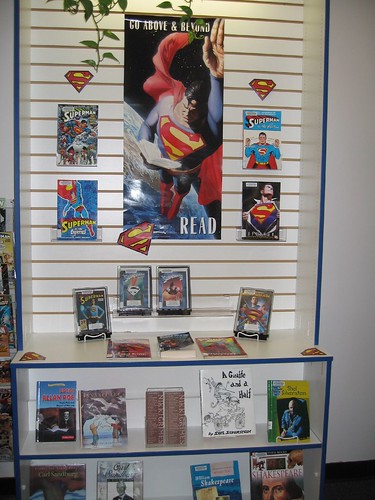
Comics in American Libraries

Teen area Superman display
McCracken County Public Library in Paducah, Kentucky
photo by Iris Garrott, CC license

More examples:
  • a teen space in an unidentified library...lots of facefront display
  • YA Area in Sunnyside Library in Fresno, California - a wall display, useful for small collections
  • YA room - Graphic novel display Marblehead, Massachusetts teen space with graphic novel display
  • Graphic Novel Collection Oak Park Library in Oak Park, Illinois teen space with graphic novel collection

Collection - Related Materials

by Emily Barney

While the first part of our collection development plan will focus on a core list of graphic novels, comics, and manga titles, it's worthwhile to remember that there are many related materials that may make the collection more accessible and interesting for library patrons with little experience in this genre.

Reference Books:
There are many, many "reference" books available for these types of materials. This small sample shows encyclopedias of characters, histories of different genres, bibliographies, literary criticism, biographies of artists and authors, and a "how to draw" book:


You can view many more examples by browsing through our Worldcat List:
Reference Books About Comics & Graphic Novels (46 items)

The titles displayed above are:
  • Goulart, Ron. 2004. Comic book encyclopedia the ultimate guide to characters, graphic novels, writers, and artists in the comic book universe. New York: HarperEntertainment.
  • Gravett, Paul. 2004. Manga sixty years of Japanese comics. London: Laurence King.
  • Gravett, Paul. 2005. Graphic novels everything you need to know. New York, NY: Collins Design.
  • Kaplan, Arie. 2006. Masters of the comic book universe revealed! Chicago: Chicago Review Press.
  • Lehmann, Timothy R. 2005. Manga masters of the art. New York: Collins Design.
  • Misiroglu, Gina Renee, and David Roach. 2004. The superhero book the ultimate encyclopedia of comic-book icons and Hollywood heroes. Detroit: Visible Ink Press.
  • Nagatomo, Haruno. 2003. Draw Your Own Manga: All the Basics. New York: Kodansha America.
  • Robbins, Trina. 1999. From girls to grrrlz a history of [women's] comics from teens to zines. San Francisco: Chronicle Books.
How to Draw Books:
Don't forget that many fans also want to try their hand at creating their own "serial art" in the style of their favorite genre. There are hundreds of different books, ranging from simple "start with a circle" drawing books to specific guides for Manga transforming robots, cat-girls and villains.

It would probably be best to look at several examples once you know what your population skill level /interest level is. There are so many, but things like the quality of the explanations and how detailed the steps are will matter a lot in how useful your users find them. Books that just show pretty pictures and say "copy this!" are frustrating for beginners!

We have a couple lists of these on our Worldcat Lists page:
http://www.worldcat.org/profiles/GothamFreeLibrary/lists
If you have a lot of kids interested in creating their own work, perhaps a contest to have their work displayed in the library would help create even more interest in the collection. Here's an example of graphic art on display in the Serieteket Library in Stockholm, Sweden:

Originally uploaded by Michael Casey Used by permission.

Using a unified format and color scheme, like this one, can make any collection of drawings look great on a wall! Having their own art in the library will also encourage kids to bring in friends and family to see their work and build a sense of community ownership in the library.

Movies & Television - see this post
Websites

by Emily Barney and Maura McKee

These websites are great resources for collection development, for finding the best ways to describe the materials, and for finding reviews and other information that can be used to share the resources with our patrons. If you're aware of other good websites, feel free to leave more addresses in the comments!

No Flying No Tights

http://www.noflyingnotights.com/index2.html
This popular website is perfect because it reviews Graphic Novels for teens.They even have a “core lists” section for librarians and teachers that want to start developing a collection.

Columbia University's Graphic Novels Page
http://www.columbia.edu/cu/lweb/eguides/graphic_novels/index.html
This website includes information about their own collection, including their collection development policy, and links to many more resources and guides. Their website provides both general-level information that would be interesting to fans and more specific information useful to librarians or anyone doing academic research in this field.

Gilles Poitras' http://www.koyagi.com
Includes a great "Librarian's Guide to Anime and Manga" and list of "Recommended Manga" as well.

Wikipedia
Wikipedia can be a wonderful source of information about these materials, often very well organized and documented with links to publishers, awards, and other relevant websites. Of course it would be wise to verify information from a more authoritative source, but the breadt h and depth of information available through these pages makes it a wonderful place to start. Here are a few of the applicable category pages where you can browse the sorts of information you can find on individual pages:
  • USA Comic Books - there are separate categories by publisher, with amazingly detailed pages giving much more information about characters and history than you'll find even in the reference books. Here's are the top ones:
  • Webcomics - This is a hard category to quantify or review, since it is constantly changing, but the Wikipedia entry is as good a place as any to begin to familiarize yourself with them.

Collection - Movies & Television

by Emily Barney and Becky Haagsma

Another related group of materials are movies and television shows based on comic books, graphic novels and manga. For Manga, the animated equivalent is called "anime," but there are also live-action versions.

Since movies and television are a more universal pop culture media than comic books right now, the popularity of these movies could help you advertise and attract more users to a graphic novel collection.

Whether or not you would ever separate them out from your DVD collection, it would be worth having a short handout available in the Graphic Novel section and vice versa to help people browse to titles they'd be interested in. Here are a few examples:

The titles displayed above are:
300 - American Splendor - AVP: Alien vs. Predator -Batman Begins - Blade - Blade II - Blade Trinity - Fantastic 4 - Fantastic 4: Rise of the Silver Surfer - Hellboy - Hulk - Popeye - Spider-Man - Spider-Man 2 - Spider-Man 3 - Superman Returns - V for Vendetta - X-Men - X2 - X-Men: The Last Stand

Movies & Television based on Comic Books:
Many popular recent movies and television shows have been based on comic book heroes and more are being planned all the time. There are also many others based on comic book "themes" and "superheroes" like Pixar's The Incredibles and NBC's Heroes.

One way to research these is to look in IMDB's keyword search. It works roughly like a "tagging" subject heading system. Here is the page for all the movies tagged "Based on a Comic book": http://www.imdb.com/keyword/based-on-comic-book/
The list of 422 items includes a few television series and is automatically sorted by rating. Sorting it by year is usually more helpful for collection development and will tell you if any new movies are being planned - which would help predict interest in graphic novel versions.

We have also created a list of popular movies based on graphic novels & comic books that can help you find these through library catalogs: Movies Based on Comic Books & Graphic Novels

Movies & Television based on Manga:
For Manga, the animated version, both for movies and television shows, is known as Anime (these are both very basic translations from Japanese - manga simply means comic in Japanese, Anime simple means animated films)

It is very common for a manga series, when it has gathered enough momentum and has a long series of books with a loyal fan base, to be converted to an anime television series. Fruits Baskets, for instance, has been extremely popular both as a Manga series and as a televise Anime series and both have been translated into English.

The website Anime on DVD has a great listing of Anime based on Manga series:
http://www.animeondvd.com/specials/manga/compcharts.php?view=manga