This website is the final group project of Becky Haagsma, Beth Snow, Emily Barney and Maura McKee in LIS501LEB with UIUC's LEEP program. We are showcasing our collection development plan for comic books and graphic novels using a fictional "library committee blog" and library "teen website."
Links to be used in the presentation:
(You can find all these links listed on every page at the top right under "Categories")
We've put together a lot more information than we'll be able to cover in seven minutes with just those links. If you enjoy the presentation we hope you'll come back and check the rest of the blog out - you can browse by reading through each page, of course, or you can check out the list of individual tags we've used to see the range of topics covered in the posts.
Thanks for visiting!
Thursday, December 6, 2007

Local Inventor believes comic books "feed the imagination," sponsors collection for youth at Gotham Free Library
article by Emily Barney
Photo by Alper Çuğun

Burt T. Wigglesworth, a local businessman and self-proclaimed "eccentric inventor" recently sold a new and improved mousetrap to a pest control company for a significant sum. Among his many generous gifts to the town of Gotham has been a $15,000 grant for Gotham Free Library to create a collection of graphic novels in their teenspace section of the library.
Wigglesworth's desire to create this collection is a reflection of his own experience with the Gotham Free Library, a personal history that goes back to his grandmother, Ms. Mildred Schiller, who served as the children's librarian from 1938-1962. "My Gram didn't believe reading comic books was an appropriate way for any young person to spend their time," says Mr. Wigglesworth. "She was thrilled that I loved to read about important scientific discoveries and help organize her collection of rare moths, but there was no way we would ever have seen a comic book in the library when she was in charge."
As a boy Mr. Wigglesworth says he had to beg other friends to let him read their comic books, but "they always seemed to give away the endings before I could get a crack at 'em. My grandmother wanted me to save all my earnings for college, so it was hard to find a way to buy any myself and Mr. Moriarty always chased us out of the drugstore if we tried to sneak a glimpse without paying. I always wished I could read these at the library, but I knew there was no money to spare in their budget even if my grandmother didn't think they were a waste of time."
With the sale of his Pulverizing Rat Impounder to Victor Products, Mr. Wigglesworth believes it's fitting that his first gifts honor the research skills his grandmother taught him at the public library. "I loved my Gram," he says, "but I think the library is better now than when she ran it. She thought the library's job was not only to provide me with books to read, but to tell me which ones I should read and how to read them. I believe the library should be a place where everyone feels welcome to explore all kinds of new experiences and ideas."
"Along with the Scientists of the Future program I've sponsored at the Wayne Academy, I'm hoping that the youth of Gotham today will enjoy this wonderful storytelling style as much as I did. It's just as important to feed the imagination and see the world as it could be as it is to build our knowledge of the world as it is."
Wednesday, December 5, 2007
Comic Libraries Around The World
You can discover more information about the Serieteket library at this website

You can view many more inspiring collections of graphic novels, comics, and manga in libraries, museums and bookshops around the world by going to "My Favorites" in Flickr.
(I suppose I should just start a group and invite all these photos to join - a project for another day).
UPDATE, 12/7: I have created the group, titled "Comics Collections" and available on flickr here. I'll leave the link to my favorites above until the group surpasses it in number of great photos. :)
Use & Users
By Emily Barney and Becky Haagsma
We believe the users are central to all aspects of planning this collection and, we hope, are reflected in every aspect of the final collection.
What would a collection be without use? The intended use is built into the grant, and we hope careful planning will make this collection fulfill Mr. Wigglesworth's wish and more:
Our collection development plan says:
Our organization & access plan says:
We believe the users are central to all aspects of planning this collection and, we hope, are reflected in every aspect of the final collection.
What would a collection be without use? The intended use is built into the grant, and we hope careful planning will make this collection fulfill Mr. Wigglesworth's wish and more:
I'm hoping that the youth of Gotham today will enjoy this wonderful storytelling style as much as I did. It's just as important to feed the imagination and see the world as it could be as it is to build our knowledge of the world as it is.
Our collection development plan says:
In order to start developing our collection, we looked for current and well-regarded resources for finding the most appropriate titles for this age group. We want to purchase content that is popular and age appropriate.
Our organization & access plan says:
Gearing the collection to teen patrons will require attention to issues of physical location/appearance of titles as well as the electronic accessibility of records. Organization and access issues take on an added layer of meaning when cultural literary differences and the wide development span of teens are thrown into the mix.
Dealing with Challenges
by Becky Haagsma
Dealing with challenges to graphic novels is similiar to dealing with any challenges in the library. However, graphic novels are at greater risk for challenges from patrons, simply because an image can be far more powerful than a written description.
It is best to be prepared for complaints.

The National Coalition Against Censorship and the ALA have produced a guide that gives several suggestions for preparing for and responding to a challenge, including the following points to focus on when responding to a challenge:
"1. Libraries provide ideas and information across the spectrum of social and political views.
2. Libraries provide choice for all people.
3. Parents are responsible for supervising their own children’s library use.
4. Collection does not imply endorsement."
The guide also gives sample answers to questions patrons might have, including the following:
"Why do libraries have to buy graphic novels?
The library has a responsibility to serve its community—your neighbors—including those you may not agree with or who may not agree with you. Libraries purchase materials, such as graphic novels, because they have a mission statement that requires them to serve a broad range of community needs and wants. The material you find in your library was selected by ibrarians, who are taught as part of their professional education to determine the needs of their communities and to select materials based on library policies."
"Graphic novels: Suggestions for Librarians." The National Coalition Against Censorship, American Library Association, and the Comic Book Legal Defense Fund. 2006. 2 Dec. 2007 http://www.ala.org/ala/oif/ifissues/graphicnovels_1.pdf.
Other Resources:
"Graphic Novel Resources." from seminar "Graphic Novels, Manga, and Anime: What's New and Cool for Your Library," ALA's Annual Conference, June 2006. 2 Dec 2007. http://www.ala.org/ala/yalsa/GraphicNovelResources.pdf
"Coping with Challenges: Strategies and Tips for Dealing with Challenges to Library Materials" ALA webpage. 2007. 2 Dec 2007. http://www.ala.org/Template.cfm?Section=dealing&Template=/ContentManagement/ContentDisplay.cfm&ContentID=77096
Kinsella, Bridget. "Libraries Developing Guidelines For Graphic Novels." Publishers Weekly 251.47 (2004) :12 , Academic Search Premier. EBSCOhost. UIUC Library. 2 Dec. 2007.
"Marshall Keeps Graphic Novels." American Libraries 38.5 (2007): 29. Academic Search Premier. EBSCOhost. UIUC Library. 2 Dec. 2007.
Dealing with challenges to graphic novels is similiar to dealing with any challenges in the library. However, graphic novels are at greater risk for challenges from patrons, simply because an image can be far more powerful than a written description.
It is best to be prepared for complaints.
The National Coalition Against Censorship and the ALA have produced a guide that gives several suggestions for preparing for and responding to a challenge, including the following points to focus on when responding to a challenge:
"1. Libraries provide ideas and information across the spectrum of social and political views.
2. Libraries provide choice for all people.
3. Parents are responsible for supervising their own children’s library use.
4. Collection does not imply endorsement."
The guide also gives sample answers to questions patrons might have, including the following:
"Why do libraries have to buy graphic novels?
The library has a responsibility to serve its community—your neighbors—including those you may not agree with or who may not agree with you. Libraries purchase materials, such as graphic novels, because they have a mission statement that requires them to serve a broad range of community needs and wants. The material you find in your library was selected by ibrarians, who are taught as part of their professional education to determine the needs of their communities and to select materials based on library policies."
"Graphic novels: Suggestions for Librarians." The National Coalition Against Censorship, American Library Association, and the Comic Book Legal Defense Fund. 2006. 2 Dec. 2007 http://www.ala.org/ala/oif/ifissues/graphicnovels_1.pdf.
Other Resources:
"Graphic Novel Resources." from seminar "Graphic Novels, Manga, and Anime: What's New and Cool for Your Library," ALA's Annual Conference, June 2006. 2 Dec 2007. http://www.ala.org/ala/yalsa/GraphicNovelResources.pdf
"Coping with Challenges: Strategies and Tips for Dealing with Challenges to Library Materials" ALA webpage. 2007. 2 Dec 2007. http://www.ala.org/Template.cfm?Section=dealing&Template=/ContentManagement/ContentDisplay.cfm&ContentID=77096
Kinsella, Bridget. "Libraries Developing Guidelines For Graphic Novels." Publishers Weekly 251.47 (2004) :12 , Academic Search Premier. EBSCOhost. UIUC Library. 2 Dec. 2007.
"Marshall Keeps Graphic Novels." American Libraries 38.5 (2007): 29. Academic Search Premier. EBSCOhost. UIUC Library. 2 Dec. 2007.
Subjects: There's More Than One Way to Skin A Cat...
Graphic collections are complex, intricate creatures. Some might refer to them as "high maintenance" in a number of realms: preservation, collection development, access, description, organization. Subject headings are no exception. Multiple factors come into play when considering what and how many subject headings to assign a record so that it can be accessed by those who need it. When the target audience itself presents special challenges, that's when the fun begins.
Library of Congress Subject Headings
These are not intuitive to our target audience (or many others, for that matter), but we will likely be requested to keep these in for consistency's sake. Using these plus any we may manufacture (see section below) will result in several subject headings showing up on each record. I don't think that will be a problem as long as the more intuitive ones are first in line.
 Here are several books that could be grouped simply or separated completely depending on the subject headings - And a list of subject headings that have appeared with these books:
Tigers -- Fiction.
Drooling -- Comic books, strips, etc.
Hobbes (Fictitious character) -- Comic books, strips, etc.
Wit and humor, Pictorial.
Cats -- Comic books, strips, etc.
Pets -- Comic books, strips, etc.
American wit and humor, Pictorial.
Cats -- Fiction.
Cartoons and comics.
Cats -- Caricatures and cartoons.
some have no subjects at all
Lexicon
Offering search terms beyond the LCSH allows further exploration of the library's collections. By meeting teens where they are, we can offer easier use of and, therefore, greater access to the collections. This can occur by using different terms for already established LCSH ("growing up" instead of "coming of age" or "memoir") or adding subject headings up front that might appear far down the line or not at all ("learning to drive", "braces", "report cards", "being grounded", "ninjas", "cats").
Tagging:
Sticking solely to LCSH focuses subject headings on lengthy phrases referring to art or drawing or comics with time period and country of origin. Adding intuitive subject headings allows teens to find what they need. Another way we can do this is by subject tagging these items. We could add it to the teen page of the website for a targeted effect; the catalog itself allows tagging, too. A tag cloud could be posted on the teen page. Teens would have an additional means of sparking their imagination with regard to reading choices.
Library of Congress Subject Headings
These are not intuitive to our target audience (or many others, for that matter), but we will likely be requested to keep these in for consistency's sake. Using these plus any we may manufacture (see section below) will result in several subject headings showing up on each record. I don't think that will be a problem as long as the more intuitive ones are first in line.
 Here are several books that could be grouped simply or separated completely depending on the subject headings - And a list of subject headings that have appeared with these books:
Tigers -- Fiction.
Drooling -- Comic books, strips, etc.
Hobbes (Fictitious character) -- Comic books, strips, etc.
Wit and humor, Pictorial.
Cats -- Comic books, strips, etc.
Pets -- Comic books, strips, etc.
American wit and humor, Pictorial.
Cats -- Fiction.
Cartoons and comics.
Cats -- Caricatures and cartoons.

some have no subjects at all
Lexicon
Offering search terms beyond the LCSH allows further exploration of the library's collections. By meeting teens where they are, we can offer easier use of and, therefore, greater access to the collections. This can occur by using different terms for already established LCSH ("growing up" instead of "coming of age" or "memoir") or adding subject headings up front that might appear far down the line or not at all ("learning to drive", "braces", "report cards", "being grounded", "ninjas", "cats").
Tagging:
Sticking solely to LCSH focuses subject headings on lengthy phrases referring to art or drawing or comics with time period and country of origin. Adding intuitive subject headings allows teens to find what they need. Another way we can do this is by subject tagging these items. We could add it to the teen page of the website for a targeted effect; the catalog itself allows tagging, too. A tag cloud could be posted on the teen page. Teens would have an additional means of sparking their imagination with regard to reading choices.
Name Authority & Secret Identities
Superhero comic books bring extra complications with their layers of secret identities that make it difficult to choose the right names and titles to organize records by series records or name subjects. But even if you can only afford to use the simplest form of the names in your catalog records, that doesn't mean the information can't be provided somewhere else.
 Wikipedia has very helpful and interesting tidbits about superhero comics characters (and manga, too); why not incorporate it? Linking to outside sources from the catalog can be time-consuming and inconvenient for both staff and patrons when the links break and there is limited time to fix the problem. Perhaps we could create a sidebar or links spot on our webpage for teens? It could be a bonus service addressing the multiple aliases/nomenclature issue as well as offering the nifty character insights (history, powers, etc.) from the Wikipedia pages.
With the Green Lantern "SuperAlias" box on Wikipedia, you can see that one hero has been "played" by many different characters over the past 67 years. Unlike Bruce Wayne, who lives forever, other superheroes do retire or relinquish their positions. Fans following the story of one character may want to sort out the previous stories and figure out allusions. Pointing them directly to Wikipedia would allow you to provide that information without having to have resident experts in your staff or update name authority records when the plots evolve further and characters continue to change.
Description: Shonen, Shōjo, and More
by Beth Snow
Bilingual and cross-cultural collections can represent an added challenge when it comes to genre names and search terms. Japanese comics and animation are good examples. Stopping the search terms with the words "manga" or "anime" can have the same effect as not going past the word "fiction" to describe the entire spectrum of novels. In addition, a good portion of our target audience is tuned into the Japanese terms for genres of manga.
To that end, I recommend we incorporate these terms into the cataloging/search descriptors for our collection. The Wikipedia article on manga offers excellent background about the form, but it's definitions are a bit messy. This link on a website devoted to explaining manga and anime to librarians does a more concise job of introducing the terms.
Series Records - Going Beyond the Titles
by Beth Snow
A big consideration when it comes to cataloging and subject headings will be the ability to locate titles in a series.
I'm not refering to actual serials publications such as the DC/Marvel/Cartoon Network subscriptions--Justice League/Fantastic Four/Cartoon Block Party, et al--but to those works with a continuing storyline and actually published in a series of individual volumes that may look like independent editions to the uninitiated. Manga usually falls into this category:
 Unlike fiction which may use a separate, distinct title for each book in a series, manga is distinguished by a number; thus, our patrons will be looking for a series title with a number listing--Fruits Basket 14, Bleach 2, etc. Teens will expect to search for a title, examine a list, and choose the volume they want.
To support access and service to patrons, I believe we should include a series search function: have a title search pull up a series name with a list of volumes in numerical order, have a series line in each record listing the name of series and volume number, have a cross-reference link to a spin-off series (Peach Girl, Peach Girl Change of Heart, Peach Girl Sae's Story, etc.). Because the stories in manga series build upon each other--much like soap operas--a series designation in the record is key help for enjoying the format.
A big consideration when it comes to cataloging and subject headings will be the ability to locate titles in a series.
I'm not refering to actual serials publications such as the DC/Marvel/Cartoon Network subscriptions--Justice League/Fantastic Four/Cartoon Block Party, et al--but to those works with a continuing storyline and actually published in a series of individual volumes that may look like independent editions to the uninitiated. Manga usually falls into this category:

To support access and service to patrons, I believe we should include a series search function: have a title search pull up a series name with a list of volumes in numerical order, have a series line in each record listing the name of series and volume number, have a cross-reference link to a spin-off series (Peach Girl, Peach Girl Change of Heart, Peach Girl Sae's Story, etc.). Because the stories in manga series build upon each other--much like soap operas--a series designation in the record is key help for enjoying the format.
Organization and Access
by Beth Snow
A new collection will always require careful planning for organization and access. It certainly wouldn't do to have great graphic novels if no one could find them. The special nature of the materials in our collection will require particular attention to the way they are cataloged and presented. Gearing the collection to teen patrons will require attention to issues of physical location/appearance of titles as well as the electronic accessibility of records. Organization and access issues take on an added layer of meaning when cultural literary differences and the wide development span of teens are thrown into the mix.
Local Access: see information about our decisions for labeling styles and display setups and view more examples from around the world in these posts tagged "Local Access"
Description:
Comics are more complex than many people realize and teens represent an equally complex audience when they come to the OPAC looking for books. It's important to understand the sorts of information teens use to look for these materials: Do they use cross cultural terms for genres? How do they search for series titles? Your descriptive information needs to be as complex as the collection and reflect the needs of the users. There are still limits, of course, to what is possible. Recognizing the limits of catalog records and finding alternate sources for detailed information will make for happier readers if they can find what they want when they want it.
Subject Access:
Although it seems to concentrate on one topic, our grant collection is as complex when it comes to subject headings as when it comes to descriptions. Genres come into play--manga, comic strips, superhero tales, graphic novels--as do storylines and subject matter. Throw a teen's lexicon into the mix, and you can see why we need to look beyond strict Library of Congress subject headings.
Search & Retrieval:
Where do you expect your user group to look for these books? Do they search the catalog to find them or browse the shelves? Labeling and Subjects and Descriptions both affect how people find the things they're looking for. But how can you help them find information about your books that you can't afford to put into the catalog? How can you help find materials you don't have?
Local Access
by Emily Barney and Becky Haagsma
Location:
Honoring the wishes of our patron Mr. Wigglesworth, who wants to create a "collection" of graphic novels in the teenspace section of the library, we've determined that these books should have a separate display and reading lounge area. Whether the comics are located on shelves or in a freestanding display, showing them face out will make a small beginning collection both more accessible and more appealing. It also helps with preservation, as Becky mentions in her post here


UPDATE: The photo posted on our teenspace website shows how a lounging area with comfortable seating and plenty of natural light attracts lots of teen readers!
Labeling:
 Rather than catalog each individual title with a Dewey Decimal call number, we have decided to label all books by author, but include a sticker to designate that they are graphic novels. This approach alleviates the need to give “non-fiction” titles a dewey decimal number.
The next step is deciding shelving order. Should all of the books be shelved by author, as with most fiction? What about series that would be separated, like the different Batman graphic novels? While it is a good idea to have a policy in place, it's important to know how users will expect to find things. Keeping the location separate and having a simple labeling system in place makes it easier to adjust the order in the future when the collection grows. Here's another example of a very broad labeling system:

The labels in the image above are simply "science fiction" "manga" and "realism"
Location:
Honoring the wishes of our patron Mr. Wigglesworth, who wants to create a "collection" of graphic novels in the teenspace section of the library, we've determined that these books should have a separate display and reading lounge area. Whether the comics are located on shelves or in a freestanding display, showing them face out will make a small beginning collection both more accessible and more appealing. It also helps with preservation, as Becky mentions in her post here
Hosted on flickr by edenprairielibrary
UPDATE: The photo posted on our teenspace website shows how a lounging area with comfortable seating and plenty of natural light attracts lots of teen readers!
Labeling:
 Rather than catalog each individual title with a Dewey Decimal call number, we have decided to label all books by author, but include a sticker to designate that they are graphic novels. This approach alleviates the need to give “non-fiction” titles a dewey decimal number.
The next step is deciding shelving order. Should all of the books be shelved by author, as with most fiction? What about series that would be separated, like the different Batman graphic novels? While it is a good idea to have a policy in place, it's important to know how users will expect to find things. Keeping the location separate and having a simple labeling system in place makes it easier to adjust the order in the future when the collection grows. Here's another example of a very broad labeling system:
The labels in the image above are simply "science fiction" "manga" and "realism"
Tuesday, December 4, 2007
Using WorldCat Lists for the big picture
by Emily Barney
WorldCat.org is an excellent tool to use if you would like to link to many sources housed in libraries around the world. To share these sources with other people, you can create a login and start making lists. You can make private lists, too, but public lists could be a great way to acquaint your local users with materials they could get using interlibrary loan if you can't afford to keep them in your collection.
Worldcat itself can sometimes be used for interlibrary loan - if your library is set up to do this, all the better reason to use these lists. You can annotate your list using the "details" tab or export citations in multiple formats by using the "citation" tab. We've created several lists for this project that you may have seen linked to in other posts, but here's the home page for them:
http://www.worldcat.org/profiles/GothamFreeLibrary/lists
I think it's pretty intuitive and fun to play with, but here's a little description if you don' t have time to play with it to figure it out:
You have to log in to add books to the lists or to make new lists. You can't comment on another person's list - it isn't a terribly "social" tool yet. It can also be hard to tell if you've already added a book when you work on adding new ones, but it still has some great features.
In the details view (the automatic tab) you can add notes about each book. The problem is, especially with long lists, you can only see 10 books at a time and it's hard to get to the end of the list.
In the "citation view" (the second tab) you can view a list of all the books in the list. You can sort the list several different ways, and you can choose between five different citation styles.
There are extra options only the person who makes the list can use:
You can write a short description paragraph that will show above the list, send the list to a group of people with a link to view it (how nice to use for a reading group or class!), or export the data. The Export data comes as a "CSV" file, which you can open as a table using most spreadsheet programs like Excel. And they have a handy print version too, that opens in a new window and will show all the books.
Sunday, December 2, 2007
Comics in American Libraries
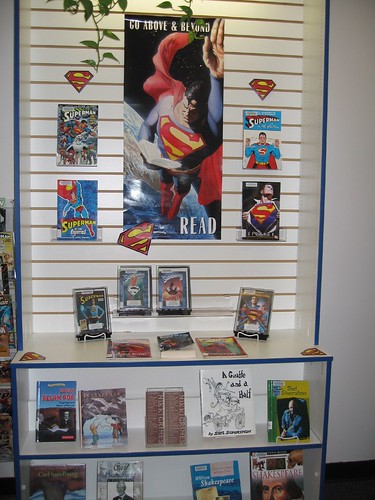 Teen area Superman display
McCracken County Public Library in Paducah, Kentucky
photo by Iris Garrott, CC license
More examples:
- a teen space in an unidentified library...lots of facefront display
- YA Area in Sunnyside Library in Fresno, California - a wall display, useful for small collections
- YA room - Graphic novel display Marblehead, Massachusetts teen space with graphic novel display
- Graphic Novel Collection Oak Park Library in Oak Park, Illinois teen space with graphic novel collection
Collection - Related Materials
by Emily Barney
While the first part of our collection development plan will focus on a core list of graphic novels, comics, and manga titles, it's worthwhile to remember that there are many related materials that may make the collection more accessible and interesting for library patrons with little experience in this genre.
Reference Books:
There are many, many "reference" books available for these types of materials. This small sample shows encyclopedias of characters, histories of different genres, bibliographies, literary criticism, biographies of artists and authors, and a "how to draw" book:

You can view many more examples by browsing through our Worldcat List:
Reference Books About Comics & Graphic Novels (46 items)
The titles displayed above are:
Don't forget that many fans also want to try their hand at creating their own "serial art" in the style of their favorite genre. There are hundreds of different books, ranging from simple "start with a circle" drawing books to specific guides for Manga transforming robots, cat-girls and villains.
It would probably be best to look at several examples once you know what your population skill level /interest level is. There are so many, but things like the quality of the explanations and how detailed the steps are will matter a lot in how useful your users find them. Books that just show pretty pictures and say "copy this!" are frustrating for beginners!
We have a couple lists of these on our Worldcat Lists page:
http://www.worldcat.org/profiles/GothamFreeLibrary/lists
Using a unified format and color scheme, like this one, can make any collection of drawings look great on a wall! Having their own art in the library will also encourage kids to bring in friends and family to see their work and build a sense of community ownership in the library.
Movies & Television - see this post
While the first part of our collection development plan will focus on a core list of graphic novels, comics, and manga titles, it's worthwhile to remember that there are many related materials that may make the collection more accessible and interesting for library patrons with little experience in this genre.
Reference Books:
There are many, many "reference" books available for these types of materials. This small sample shows encyclopedias of characters, histories of different genres, bibliographies, literary criticism, biographies of artists and authors, and a "how to draw" book:

You can view many more examples by browsing through our Worldcat List:
Reference Books About Comics & Graphic Novels (46 items)
The titles displayed above are:
- Goulart, Ron. 2004. Comic book encyclopedia the ultimate guide to characters, graphic novels, writers, and artists in the comic book universe. New York: HarperEntertainment.
- Gravett, Paul. 2004. Manga sixty years of Japanese comics. London: Laurence King.
- Gravett, Paul. 2005. Graphic novels everything you need to know. New York, NY: Collins Design.
- Kaplan, Arie. 2006. Masters of the comic book universe revealed! Chicago: Chicago Review Press.
- Lehmann, Timothy R. 2005. Manga masters of the art. New York: Collins Design.
- Misiroglu, Gina Renee, and David Roach. 2004. The superhero book the ultimate encyclopedia of comic-book icons and Hollywood heroes. Detroit: Visible Ink Press.
- Nagatomo, Haruno. 2003. Draw Your Own Manga: All the Basics. New York: Kodansha America.
- Robbins, Trina. 1999. From girls to grrrlz a history of [women's] comics from teens to zines. San Francisco: Chronicle Books.
Don't forget that many fans also want to try their hand at creating their own "serial art" in the style of their favorite genre. There are hundreds of different books, ranging from simple "start with a circle" drawing books to specific guides for Manga transforming robots, cat-girls and villains.
It would probably be best to look at several examples once you know what your population skill level /interest level is. There are so many, but things like the quality of the explanations and how detailed the steps are will matter a lot in how useful your users find them. Books that just show pretty pictures and say "copy this!" are frustrating for beginners!
We have a couple lists of these on our Worldcat Lists page:
http://www.worldcat.org/profiles/GothamFreeLibrary/lists
If you have a lot of kids interested in creating their own work, perhaps a contest to have their work displayed in the library would help create even more interest in the collection. Here's an example of graphic art on display in the Serieteket Library in Stockholm, Sweden:


Using a unified format and color scheme, like this one, can make any collection of drawings look great on a wall! Having their own art in the library will also encourage kids to bring in friends and family to see their work and build a sense of community ownership in the library.
Movies & Television - see this post
Describing Multi-Format Titles
by Beth Snow
Many teens search intuitively by format, so including format descriptions in the subject headings may make the collections more accessible than relying only on publication data in the descriptions.
Manga, comic strip collections, subscription/serial comics, and graphic novels each have distinguishable features. Teens easily recognize this and often search based upon these characteristics--why not "meet them where they are"? If they are looking for a title or character, let's be up front and indicate the format using a teen's lexicon: manga (for both traditional and Americanized front-to-back versions), comic strips (collections of comic strips appearing originally in paper or electronic format), graphic novels (fiction or non-fiction subject matter bound in book form--could put superhero compilations here perhaps--definitely includes illustrated classics).
But don't forget that a title can appear in more than one format and a person who's interested in one version will probably be interested in another. For example, here's a volume of Harvey Pekar's American Splendor comics and the movie American Splendor, both based on his life:
 In this case the title is exactly the same - what role should description information and subject headings play in connecting both of these when you're searching?
Collection Development
by Maura McKee
Graphic Novels n. A novel whose narrative is related through a combination of text and art, often in comic-strip form.
"graphic novel." (2003). In The American Heritage® Dictionary of the English Language. Retrieved November 08, 2007, from http://www.credoreference.com/entry/4092450graphic novel.
Graphic Novels n. A novel whose narrative is related through a combination of text and art, often in comic-strip form.
"graphic novel." (2003). In The American Heritage® Dictionary of the English Language. Retrieved November 08, 2007, from http://www.credoreference.com/entry/4092450graphic novel.
Since our grant determines our collection to be part of our Young Adult population, we have defined this as teens ages 12-18. In order to start developing our collection, we looked for current and well-regarded resources for finding the most appropriate titles for this age group. We want to purchase content that is popular and age appropriate. The term graphic novel for our collection will include manga titles and collections of comics in book format.
The first step in building this collection involved finding sources for reviews of graphic novels, determining awards specific to this genre, and compiling a list of popular publishers of graphic novels. We then chose the best reference books, websites, and catalogs for title recommendations.
After finding graphic novels for our collection we will likely expand our titles to include reference, drawing, and movie titles based on the comic book genre. Below you will find the top resources we found necessary for creating our graphic novel collection, including where to buy titles for this genre and where we will house our collection in the library.
Print Reviews:
 Publisher’s Weekly - http://www.publishersweekly.com
Published weekly
Includes Comics reviews for children and teens. Current best sellers, prize winners. Recent March 5, 2007 issue covers the 2007 Comic-con show in New York
 Booklist - http://www.ala.org/booklist/
Published twice monthly, includes graphic novel reviews
Recent March 15, 2007 issue “Spotlight on Graphic Novels” End of the year “Best Books” includes best graphic novels for teens. The ALA website also includes a YALSA sponsored “Great Graphic Novels for Teens” section. Here you will find 2007 nominations and winners, and well as, current nominations for 2008:
"Great Graphic Novels For Teens" website
http://www.ala.org/ala/yalsa/booklistsawards/greatgraphicnovelsforteens/gn.cfm
The Comics Journal http://www.tcj.com/
Published monthy
Provides industry news, interviews, and current reviews
School Library Journal http://www.slj.com
Published monthly
Includes starred reviews, best books of the year list in December issue
There are also many articles indexed in Wilson Web's Library Lit database. The two main subject areas are "comic books, strips, etc" and "graphic novels." If you search for these subject headings under "browse" you will find nice subheadings like "exhibits and displays" and "selection."
- Useful journals indexed by LibraryLit database:
- Library Journal
- Library Media Connection
- Young Adult Library Services
- several of the ones listed above as well.
Published Guides:
 The 101 Best Graphic Novels by Stephen Weiner, 2005 (1-56163-444-1)
This is a great title because every book in this list is assigned a reading level of :
- “C” for all ages, (especially 12 and under),
- “Y” for readers 12 and 15,
- “Y+” for teens 16-19,
- or “A” for adult readers ages 20 and up.
This is a good starting point to pick out the best titles that might fall in either the Y or Y+ category. For the purposes of our age group, we would likely start with the Y titles before choosing Y+. Stephen Weiner is a public library director and comics historian.
Developing and Promoting Graphic Novel Collections by Steve Miller, 2005 (9781555704612)
This thorough volume explains the details of developing, acquiring, cataloging, maintaining, and making displays for graphic novel collection in libraries.
To view examples of other reference books, see this post.
Or view our WorldCat list of 46 more titles here:
Collection Development for Comics, Manga, and Graphic Novels
Websites - see this post
Publishers - see this post
Catalogs & Booksellers:
- H.W. Wilson Core Collections http://www.corecollections.net/graphicnovels_copy(1).htm
- Provides recent picks for graphic novel and manga titles. Good source for finding current, popular titles. Also provides price, review sources, and reading levels.
- Brodart - http://www.graphicnovels.brodart.com/home.htm
- Maintains a graphic novel selection with core lists for long term availability. Other features include “New This Month” and Spanish Titles.
- Booksellers offering library discounts from 20-45%
- Ingram
- BWI
- Brodart
- Baker & Taylor
- Local Comic Book Shops or Bookstores
(includes more reference books, how to draw books, movies and television series)
Publishers
by Emily Barney and Maura McKee
Besides needing to be aware of major sources for collection development purposes, it's important to understand the "structure" behind comic book series, because many readers will. Publishers, especially for comic book titles, should be an easy field you can use in the catalog to search and retrieve lists of similar items.
Many of these materials are published by a short list of major distributors. If you're not familiar with comic books, you will find very useful information organized about them under the Wikipedia Category for US Comic book publishing companies, especially the DC or Marvel sections. See our Websites post for more examples of Wikipedia pages by genre.
Since many fans will follow characters across many titles within these publishers - and perhaps refer to them as fictional "worlds," like "Superman is in the DC Universe," it's a good idea to have a general understanding, especially for superhero comic books, which characters are published by which groups.
These lists are by no means comprehensive, but they'll give you a good start.
- Major Comic Book Publishers
- DC - http://www.dccomics.com/
- Vertigo - http://www.dccomics.com/vertigo/
- Wildstorm - http://www.dccomics.com/wildstorm/
- Marvel - http://www.marvelcomics.com/
- Image Comics - http://www.imagecomics.com/
- Dark Horse - http://www.darkhorse.com/
- Major Graphic Novel Publishers
- Fantagraphics - http://www.fantagraphics.com/
- Drawn & Quarterly - http://www.drawnandquarterly.com/index.php
- Top Shelf Productions - http://www.topshelfcomix.com/
- Major Manga Publishers -
- TokyoPop - http://www.tokyopop.com/
- Viz Media - http://www.viz.com/
- for more, see the list of Manga Distributors in English on Wikipedia here
- Major Comics/Cartoons Publishers - (many mainstream publishers as well)
- Fantagraphics - http://www.fantagraphics.com/ (they do graphic novels & comics)
- Andrew McMeels - http://www.andrewsmcmeel.com/cartoon_books.html
- Archie Comics - http://www.archiecomics.com/
Websites
by Emily Barney and Maura McKee
These websites are great resources for collection development, for finding the best ways to describe the materials, and for finding reviews and other information that can be used to share the resources with our patrons. If you're aware of other good websites, feel free to leave more addresses in the comments!
No Flying No Tights
http://www.noflyingnotights.com/index2.html
This popular website is perfect because it reviews Graphic Novels for teens.They even have a “core lists” section for librarians and teachers that want to start developing a collection.
Columbia University's Graphic Novels Page
http://www.columbia.edu/cu/lweb/eguides/graphic_novels/index.html
This website includes information about their own collection, including their collection development policy, and links to many more resources and guides. Their website provides both general-level information that would be interesting to fans and more specific information useful to librarians or anyone doing academic research in this field.
Gilles Poitras' http://www.koyagi.com
Includes a great "Librarian's Guide to Anime and Manga" and list of "Recommended Manga" as well.
Wikipedia
Wikipedia can be a wonderful source of information about these materials, often very well organized and documented with links to publishers, awards, and other relevant websites. Of course it would be wise to verify information from a more authoritative source, but the breadt h and depth of information available through these pages makes it a wonderful place to start. Here are a few of the applicable category pages where you can browse the sorts of information you can find on individual pages:
- USA Comic Books - there are separate categories by publisher, with amazingly detailed pages giving much more information about characters and history than you'll find even in the reference books. Here's are the top ones:
- Comic Strips (this category is primarily for "funnies" style comics)
- Graphic Novels - less useful than the Comic Book categories, but may grow in the future
- Webcomics - This is a hard category to quantify or review, since it is constantly changing, but the Wikipedia entry is as good a place as any to begin to familiarize yourself with them.
Awards
by Maura McKee and Emily Barney
Graphic novels have won awards in many categories, including a Pulitzer Prize for Art Spiegelman’s graphic novel Maus: A Survivor’s Tale, a memoir of his father’s survival of the holocaust.¹ There are also many awards dedicated just to comic books by genre or for achievement in specific fields.
The Hahnl Library's Comic Book Awards Almanac includes a glossary that explains the differences between these awards, from festival awards to nominations, polls and special selection awards.
You can find more information about the different awards on specific pages on Wikipedia including "Comic Book Awards," "Anime and Manga Awards" and "Award-Winning Graphic Novels"
Examples of awards given in this field:
 American Born Chinese, a graphic novel by Gene Luen Yang won the 2007 Michael L. Prinz Award for literary excellence in young adult literature. The novel interweaves three different stories:
 Jeff Smith's Bone is the longest-running self-published series so far and has won more awards than any other comic in history. It began with the whimsical adventures of Phone Bone and developed into an intricate world with monsters and dragons waging war against the forest creatures under the leadership of a cow-racing grandmother. It was released between 1991 and 2004, as 55 irregularly-released issues that were printed in 9 individual volumes and eventually gathered into one major volume, pictured here. This series has won 44 awards in America and around the world, including 10 Eisner Awards and 11 Harvey Awards.²
More information about the artist and series is available at http://www.boneville.com/
 Harvey Pekar and his wife Joyce Brabner wrote Our Cancer Year as he dealt with the discovery of his lymphoma and its treatment. The book was illustrated by Frank Stark, an award-winning professor of art at the University of Missouri. This volume won the 1995 best graphic album Harvey Award. Pekar had already won the American Book Award in 1987 for his American Splendor series. Pekar's life story -- including how he met and married Joyce Brabner, and how he experienced cancer and its treatment -- was made into an excellent film, American Splendor (2003).³
More information about the author and other graphic novels by him and his wife are available at http://www.harveypekar.com/
 Linda Medley's Castle Waiting was in YALSA's 2007 Top Ten Great Graphic Novels for Teens, and Booklist's Top 10 Graphic Novels for Youth. It has also won 2 Harvey Awards and 7 Eisner awards, including the 1998 Best New Series Eisner Award. Medley began the series in 1996 and volume one was published in 2006. The series begins with a short retelling of the Sleeping Beauty fairy tale, but once she has left for her happily ever after the castle becomes a refuge for marginal fairy tale creatures and characters, telling stories of unconventional convents and enterprising uses of the goose who laid the golden egg.
More information about the author and her book is available here: http://www.fantagraphics.com/artist/medley/medley.html
 Don Rosa's Life and Times of $crooge McDuck explains how the "richest duck in the world" won his fortune between 1877 and 1947. This historical fiction follows his adventures from Scotland to America and beyond to the African Transvaal, Australia, and the Klondike, encountering figures like Theodore Roosevelt. Published from April 1994 to February 1996, it won the 1995 Eisner Award for Best Serialized Story and the 1995 Comic Buyers Guide Fan Awards for Favorite Comic Book
More information is available about the series on Don Rosa's "The IntroDUCKtion to the Life and Times of $crooge McDuck"
¹ Kakutani, Michiko. "Books of The Times; Rethinking the Holocaust With a Comic Book." New York Times. October 29, 1991
² "The History of BONE & Jeff Smith" http://www.boneville.com/bone/bone-history/
³ Kohn, Martin "Brabner, Joyce and Pekar, Harvey: Our Cancer Year" Literature, Arts & Medicine Database 14 April 2005 http://litmed.med.nyu.edu/Annotation?action=view&annid=383
Graphic novels have won awards in many categories, including a Pulitzer Prize for Art Spiegelman’s graphic novel Maus: A Survivor’s Tale, a memoir of his father’s survival of the holocaust.¹ There are also many awards dedicated just to comic books by genre or for achievement in specific fields.
The Hahnl Library's Comic Book Awards Almanac includes a glossary that explains the differences between these awards, from festival awards to nominations, polls and special selection awards.
You can find more information about the different awards on specific pages on Wikipedia including "Comic Book Awards," "Anime and Manga Awards" and "Award-Winning Graphic Novels"
Examples of awards given in this field:
- Eisner Award - FAQ on comic-con international website
- Given for creative achievement in American comic books; named in honor of comic book writer and artist Will Eisner
- Harvey Awards - http://www.harveyawards.org/
- This series, named after writer artist Harvey Kurtzman, includes awards for achievement in writing, art, humor, letterer, colorist, new talent, etc. with comic books.
- Ignatz Awards - http://www.spxpo.com/ignatz.shtml
- Named for the character in the classic comic strip Krazy Kat by George Herriman this is a festival prize that recognizes outstanding achievement in comics and cartooning with special prizes in ten different categories.
 American Born Chinese, a graphic novel by Gene Luen Yang won the 2007 Michael L. Prinz Award for literary excellence in young adult literature. The novel interweaves three different stories:
one is a folk tale of "The Monkey King", another is the story of a second-generation immigrant named Jin Wang, and the third is about Danny, a boy with a Chinese cousin named Chin-Kee. The book's climax merges all of these stories together.
More information about the author and the series is available at:
http://www.humblecomics.com/
More information about the author and the series is available at:
http://www.humblecomics.com/
 Jeff Smith's Bone is the longest-running self-published series so far and has won more awards than any other comic in history. It began with the whimsical adventures of Phone Bone and developed into an intricate world with monsters and dragons waging war against the forest creatures under the leadership of a cow-racing grandmother. It was released between 1991 and 2004, as 55 irregularly-released issues that were printed in 9 individual volumes and eventually gathered into one major volume, pictured here. This series has won 44 awards in America and around the world, including 10 Eisner Awards and 11 Harvey Awards.²
More information about the artist and series is available at http://www.boneville.com/
 Harvey Pekar and his wife Joyce Brabner wrote Our Cancer Year as he dealt with the discovery of his lymphoma and its treatment. The book was illustrated by Frank Stark, an award-winning professor of art at the University of Missouri. This volume won the 1995 best graphic album Harvey Award. Pekar had already won the American Book Award in 1987 for his American Splendor series. Pekar's life story -- including how he met and married Joyce Brabner, and how he experienced cancer and its treatment -- was made into an excellent film, American Splendor (2003).³
More information about the author and other graphic novels by him and his wife are available at http://www.harveypekar.com/
 Linda Medley's Castle Waiting was in YALSA's 2007 Top Ten Great Graphic Novels for Teens, and Booklist's Top 10 Graphic Novels for Youth. It has also won 2 Harvey Awards and 7 Eisner awards, including the 1998 Best New Series Eisner Award. Medley began the series in 1996 and volume one was published in 2006. The series begins with a short retelling of the Sleeping Beauty fairy tale, but once she has left for her happily ever after the castle becomes a refuge for marginal fairy tale creatures and characters, telling stories of unconventional convents and enterprising uses of the goose who laid the golden egg.
More information about the author and her book is available here: http://www.fantagraphics.com/artist/medley/medley.html
 Don Rosa's Life and Times of $crooge McDuck explains how the "richest duck in the world" won his fortune between 1877 and 1947. This historical fiction follows his adventures from Scotland to America and beyond to the African Transvaal, Australia, and the Klondike, encountering figures like Theodore Roosevelt. Published from April 1994 to February 1996, it won the 1995 Eisner Award for Best Serialized Story and the 1995 Comic Buyers Guide Fan Awards for Favorite Comic Book
More information is available about the series on Don Rosa's "The IntroDUCKtion to the Life and Times of $crooge McDuck"
¹ Kakutani, Michiko. "Books of The Times; Rethinking the Holocaust With a Comic Book." New York Times. October 29, 1991
² "The History of BONE & Jeff Smith" http://www.boneville.com/bone/bone-history/
³ Kohn, Martin "Brabner, Joyce and Pekar, Harvey: Our Cancer Year" Literature, Arts & Medicine Database 14 April 2005 http://litmed.med.nyu.edu/Annotation?action=view&annid=383
Collection - Movies & Television
by Emily Barney and Becky Haagsma
Another related group of materials are movies and television shows based on comic books, graphic novels and manga. For Manga, the animated equivalent is called "anime," but there are also live-action versions.
Since movies and television are a more universal pop culture media than comic books right now, the popularity of these movies could help you advertise and attract more users to a graphic novel collection.
Whether or not you would ever separate them out from your DVD collection, it would be worth having a short handout available in the Graphic Novel section and vice versa to help people browse to titles they'd be interested in. Here are a few examples:
 The titles displayed above are:
300 - American Splendor - AVP: Alien vs. Predator -Batman Begins - Blade - Blade II - Blade Trinity - Fantastic 4 - Fantastic 4: Rise of the Silver Surfer - Hellboy - Hulk - Popeye - Spider-Man - Spider-Man 2 - Spider-Man 3 - Superman Returns - V for Vendetta - X-Men - X2 - X-Men: The Last Stand
Movies & Television based on Comic Books:
Many popular recent movies and television shows have been based on comic book heroes and more are being planned all the time. There are also many others based on comic book "themes" and "superheroes" like Pixar's The Incredibles and NBC's Heroes.
One way to research these is to look in IMDB's keyword search. It works roughly like a "tagging" subject heading system. Here is the page for all the movies tagged "Based on a Comic book": http://www.imdb.com/keyword/based-on-comic-book/
The list of 422 items includes a few television series and is automatically sorted by rating. Sorting it by year is usually more helpful for collection development and will tell you if any new movies are being planned - which would help predict interest in graphic novel versions.
We have also created a list of popular movies based on graphic novels & comic books that can help you find these through library catalogs: Movies Based on Comic Books & Graphic Novels
Movies & Television based on Manga:
For Manga, the animated version, both for movies and television shows, is known as Anime (these are both very basic translations from Japanese - manga simply means comic in Japanese, Anime simple means animated films)
It is very common for a manga series, when it has gathered enough momentum and has a long series of books with a loyal fan base, to be converted to an anime television series. Fruits Baskets, for instance, has been extremely popular both as a Manga series and as a televise Anime series and both have been translated into English.
The website Anime on DVD has a great listing of Anime based on Manga series:
http://www.animeondvd.com/specials/manga/compcharts.php?view=manga
Subscribe to:
Posts (Atom)